

Dog Trainer Reno: What Professional Trainers Look for During a First Behavior Assessment
Understanding the Purpose of a Behavior Assessment
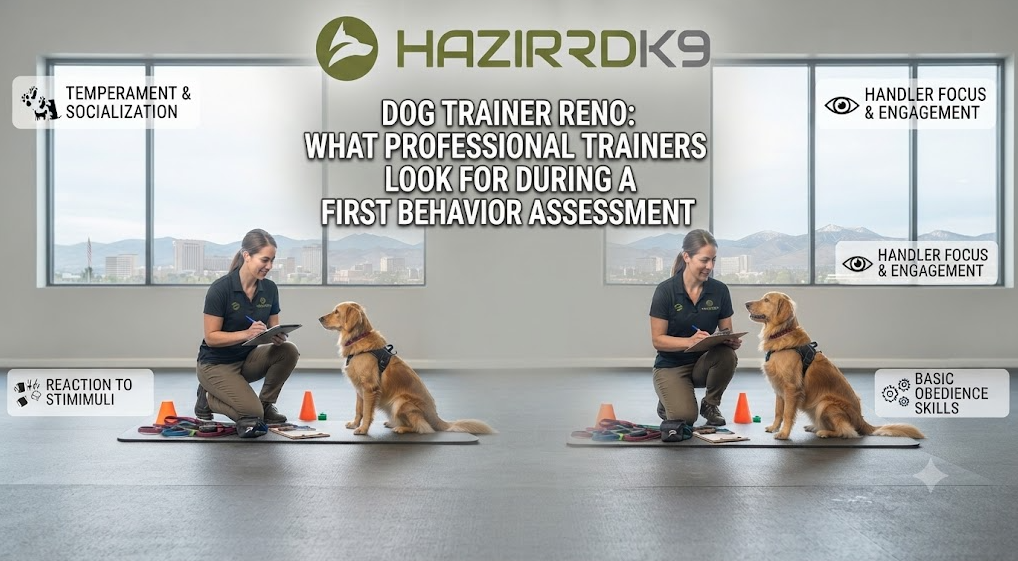
A first behavior assessment gives a professional dog trainer an opportunity to understand how a dog responds to its environment, people, animals, and everyday situations. We use this initial meeting to observe the dog before recommending specific training methods or behavior strategies. The assessment is not simply about identifying commands a dog already knows or does not know. Instead, it helps us understand patterns that may influence obedience, confidence, communication, and overall behavior. A professional dog trainer in Reno may also use this session to identify triggers that cause excitement, fear, frustration, avoidance, or defensive responses. At Hazard K9, we focus on gathering practical information that can help create a training approach suited to the individual dog.
Observing the Dog's Body Language
Body language provides important information about how a dog experiences a particular situation. During an assessment, we carefully observe posture, facial expressions, tail position, ear movement, eye contact, and changes in physical tension. These signals can help indicate whether a dog is relaxed, uncertain, excited, overwhelmed, or preparing to react. We also pay attention to how quickly the dog's body language changes when something new enters the environment. A dog that appears calm initially may display subtle signs of discomfort when approached by a stranger or introduced to an unfamiliar setting. Understanding these details helps professional trainers avoid relying only on obvious behaviors such as barking, growling, jumping, or pulling.
Evaluating Responses to New People
A professional trainer often observes how a dog responds when an unfamiliar person enters the training environment. Some dogs immediately approach people with enthusiasm, while others remain distant or cautious until they feel comfortable. We look at whether the dog seeks interaction, avoids contact, becomes overly excited, or displays signs of nervousness. The trainer may also observe how the dog responds to different movements, voices, and approaches from people. These observations can reveal whether the dog's behavior is primarily social excitement, uncertainty, fear, or a lack of appropriate boundaries. This information is valuable when developing practical training strategies for homes, public spaces, and other everyday environments.
Assessing Reactions to Other Dogs
Interactions with other dogs can reveal behavioral patterns that may not appear during one-on-one human interaction. During an assessment, we consider how a dog reacts when another dog is visible, nearby, or moving through the same environment. We look for signs of curiosity, playfulness, excitement, avoidance, tension, frustration, or reactivity. The distance between dogs can also affect behavior, so professional trainers pay attention to the point at which a dog begins showing noticeable changes. We do not assume that barking or pulling automatically means aggression because similar behaviors can have different causes. A careful assessment helps determine what circumstances contribute to the reaction and what training approach may be appropriate.
Looking at Leash Behavior
Leash behavior is another important part of a first assessment because it can show how a dog manages excitement, frustration, distractions, and handler communication. We observe whether the dog walks with a loose leash, constantly pulls forward, changes direction frequently, or becomes distracted by people, animals, sounds, and smells. We also evaluate how the dog responds when the handler changes speed or direction. A dog that pulls consistently may need more than basic leash practice if the behavior is connected to environmental triggers or excessive excitement. Professional trainers therefore consider the reason behind the pulling instead of treating every leash problem in exactly the same way. This approach can make future training more focused and easier for the owner to continue.
Identifying Triggers and Behavioral Patterns
Identifying triggers is one of the most useful objectives of an initial behavior assessment. Triggers can include unfamiliar people, other dogs, vehicles, noises, specific locations, physical handling, or changes in routine. We ask owners about situations in which their dogs commonly become difficult to manage because these details provide important context for what happens during the assessment. We also look for patterns that may connect a dog's environment with its reactions. A dog may appear well behaved in a quiet training area but respond differently in crowded or stimulating locations. Understanding these patterns allows a professional dog trainer in Reno to develop strategies that address behavior in realistic situations rather than focusing only on isolated exercises.
Evaluating Basic Obedience and Communication
Basic obedience provides another useful window into how a dog communicates with its handler. We may observe responses to cues such as sit, down, stay, recall, place, or walking beside the handler. The goal is not simply to count how many commands the dog knows. We are also interested in whether the dog understands the cue, chooses to respond, becomes distracted, or looks to the handler for additional guidance. The trainer may observe whether communication changes when distractions are introduced into the environment. These observations can help identify whether the next stage of training should focus on foundation skills, consistency, impulse control, engagement, or more advanced obedience work.
Assessing Impulse Control
Impulse control plays a significant role in how dogs handle everyday situations. During an assessment, we may observe how the dog behaves around food, toys, doors, people, other animals, and exciting environmental changes. A dog that immediately rushes toward every distraction may need structured exercises that teach patience and controlled decision-making. We also consider whether the handler can redirect the dog's attention once excitement begins to increase. Strong impulse control does not mean eliminating a dog's natural enthusiasm or curiosity. Instead, training can help the dog learn when it is appropriate to engage and when it should remain calm and responsive.
Considering Confidence and Environmental Awareness
Confidence can influence how a dog responds to unfamiliar surroundings and unexpected experiences. We observe how the dog moves through different spaces, encounters unfamiliar surfaces, hears new sounds, and experiences changes around it. Some dogs investigate new environments immediately, while others need additional time before becoming comfortable. We pay attention to whether the dog recovers quickly after an unexpected sound or movement. Recovery can provide useful information about how the dog manages environmental pressure and how much support may be needed during training. A professional assessment considers these reactions because confidence and environmental awareness can influence obedience, social behavior, and overall responsiveness.
Discussing the Dog's History With the Owner
The dog's history is an essential part of a meaningful behavior assessment. We ask owners about previous training, household routines, social experiences, behavioral concerns, and situations that have caused difficulties. Information about when a behavior first appeared can be particularly useful because timing may help clarify the circumstances surrounding the change. We also want to understand what the owner has already tried and how the dog responded to those efforts. Every dog has an individual history, so relying on assumptions can lead to an approach that does not fit the situation. Combining owner information with direct observation gives the trainer a more complete picture of the dog's current behavior.
Reviewing the Home Environment
A dog's behavior is strongly influenced by its daily environment, which is why professional trainers often discuss what happens at home. We may ask about feeding routines, sleeping arrangements, exercise, household rules, visitors, other pets, and opportunities for structured activity. We also consider how family members interact with the dog and whether expectations are consistent across the household. Differences in routines or communication can sometimes make it harder for a dog to understand what is expected. The assessment therefore looks beyond the training session and considers the circumstances surrounding the dog's everyday behavior. This broader perspective helps create recommendations that owners can realistically maintain over time.
Evaluating Handler and Dog Communication
Training involves communication between the dog and the person handling it, so both sides are considered during an assessment. We observe how the owner gives cues, responds to unwanted behavior, rewards desired behavior, and manages distractions. The trainer may identify moments when the dog understands the handler but loses focus because the environment becomes too stimulating. We also look for opportunities to improve timing, consistency, positioning, and communication. Effective training is not only about teaching a dog what to do but also helping the owner understand how to communicate clearly. At Hazard K9, we use these observations to help establish practical training habits that can continue beyond the initial assessment.
Recognizing Stress and Overstimulation
Dogs can behave differently when they become stressed or overstimulated, making it important to recognize early signs during an assessment. We watch for changes such as excessive panting, pacing, avoidance, repetitive movement, freezing, increased vocalization, or difficulty responding to familiar cues. These signs can indicate that the dog is having difficulty processing the current environment. A professional trainer needs to distinguish between deliberate disobedience and behavior that occurs because the dog is overwhelmed. Recognizing this difference can help prevent training sessions from becoming unnecessarily difficult for both the dog and owner. It also allows the trainer to determine when adjustments in distance, activity level, or environmental pressure may be appropriate.
Developing an Individual Training Direction
The purpose of a first behavior assessment is ultimately to collect enough information to develop a suitable training direction. We consider the dog's temperament, current skills, environmental responses, triggers, household circumstances, and the owner's goals before determining the next steps. Training recommendations should reflect what the dog actually demonstrates rather than relying on a generic program. Some dogs may need foundational obedience, while others may require structured work around specific distractions or behavioral challenges. The trainer can also explain which behaviors should be addressed first and which skills can be developed later. This individualized process helps establish realistic expectations and creates a clearer path for continued training.
What Owners Should Expect From the First Session
Owners should expect the first assessment to involve observation, questions, interaction, and discussion rather than a simple test of obedience. We want to understand how the dog behaves naturally and how different situations influence its responses. The trainer may ask the owner to describe specific incidents and demonstrate how they currently handle certain behaviors. This gives the trainer an opportunity to see the relationship between the dog's actions and the handler's responses. Owners should also feel comfortable discussing concerns honestly because accurate information makes the assessment more useful. A professional dog trainer in Reno can then use the combined observations to explain practical training priorities and possible next steps.
Building a Practical Training Plan
A successful training plan should be realistic enough for owners to apply consistently in everyday life. We consider the dog's current abilities, the family's schedule, the environments where problems occur, and the specific behaviors that need attention. Training may involve structured obedience, leash work, impulse control, environmental exposure, engagement exercises, or behavior modification depending on the assessment. Progress should be measured through observable changes rather than vague expectations. Owners can then understand what they are working toward and how daily practice contributes to the process. With the right information from the initial assessment, training can become a structured process focused on clearer communication and more reliable behavior.
Why the First Assessment Matters
A first behavior assessment establishes a foundation for understanding the dog as an individual rather than treating every behavioral issue the same way. We examine the dog's body language, environmental reactions, obedience, impulse control, social responses, triggers, and relationship with its handler. These observations help identify the circumstances that influence behavior and the skills that may require additional development. They also give owners an opportunity to explain their concerns and understand what professional training can realistically address. At Hazard K9, we use the assessment process to build a clearer picture of each dog's needs before moving into a structured training program. A thoughtful first assessment can therefore provide the direction needed to make future training more focused, consistent, and practical.
