

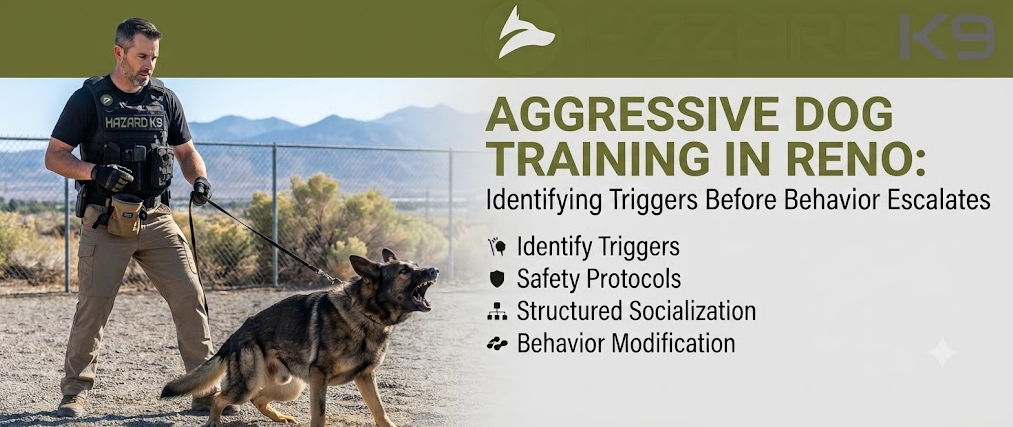
Aggressive Dog Training in Reno: Identifying Triggers Before Behavior Escalates
Understanding Aggression Before It Escalates
Aggressive behavior in dogs can develop from fear, frustration, anxiety, territorial instincts, resource guarding, or previous negative experiences. Growling, stiff body language, barking, lunging, snapping, and intense staring can all indicate that a dog is becoming uncomfortable. These behaviors should not simply be viewed as disobedience because they often communicate that a dog is struggling to manage a particular situation. Early recognition gives owners an opportunity to address the underlying trigger before the reaction becomes stronger. In Reno, dogs may encounter busy sidewalks, unfamiliar people, other animals, changing environments, and situations that challenge their sense of security. At Hazard K9, we focus on understanding these warning signs so our training can address behavior before it reaches a more dangerous stage.
Why Identifying Triggers Matters
Every dog has different experiences, sensitivities, and thresholds that influence how it responds to stressful situations. A trigger may be another dog approaching, a stranger entering the home, someone touching a food bowl, sudden movement, loud noises, or being restrained. Some dogs react immediately, while others show subtle signs of discomfort before displaying obvious aggression. Identifying these early signals helps owners understand when their dog is approaching its threshold. Once a trigger is recognized, training can focus on changing the dog's response instead of simply correcting the visible behavior. This creates a more structured approach to aggressive dog training and helps owners make safer decisions during everyday situations.
Recognizing Early Warning Signals
Dogs often communicate discomfort through body language long before they bark, lunge, or snap. A dog may freeze, turn its head away, lower its body, pin its ears back, raise its hackles, lick its lips, or repeatedly stare at a perceived threat. Other dogs may become unusually still and focused before suddenly reacting. Learning to recognize these signals allows handlers to create distance and reduce pressure before the dog's emotional response intensifies. Owners should pay attention to changes in posture, facial expression, movement, breathing, and attention because these details can reveal when a dog is becoming uncomfortable. Early recognition is one of the most practical skills we teach when helping owners manage challenging canine behavior.
Common Triggers in Reno Dogs
Dogs living in Reno can experience many different environments that may expose them to unfamiliar sights, sounds, people, and animals. Busy parks, apartment communities, neighborhood walks, veterinary visits, boarding facilities, and public spaces can all create situations that challenge a reactive or aggressive dog. Heat, unfamiliar surroundings, physical discomfort, lack of exercise, and excessive stimulation may also affect how a dog responds to its environment. A trigger does not always have to be another animal because people, objects, sounds, locations, or specific handling situations can produce strong reactions. Understanding the exact circumstances surrounding an incident can help owners identify patterns instead of treating every aggressive response as an isolated event. Careful observation provides the foundation for creating a training plan that addresses the dog's individual needs.
Understanding the Distance Threshold
Many reactive dogs have a specific distance at which they can notice a trigger without immediately reacting. This distance is sometimes described as a threshold because the dog's ability to process the situation changes as the trigger gets closer. A dog that remains calm when another dog is fifty feet away may bark, lunge, or snap when that same dog approaches within ten feet. Repeatedly pushing a dog beyond this threshold can make training more difficult because the animal may become overwhelmed before learning can take place. We work to identify manageable distances where the dog can notice a trigger while still responding to handler guidance. Gradually working within that manageable range can help create better communication and more controlled responses.
The Role of Fear and Anxiety
Fear is a common factor behind aggressive behavior, particularly when a dog believes that a person, animal, or situation represents a threat. A fearful dog may attempt to increase distance by barking, growling, lunging, or snapping when it feels that escape is unavailable. Punishing these warning behaviors without addressing the underlying fear can sometimes make communication more difficult. The dog may learn that showing warning signals results in punishment while still feeling uncomfortable about the original trigger. Effective training should therefore consider what is causing the emotional response and how the dog can learn a safer alternative. Our approach emphasizes controlled situations, clear communication, and consistent handling to help owners better understand the reasons behind their dog's reactions.
Resource Guarding and Possession Triggers
Some dogs display aggressive behavior when people or animals approach food, toys, resting areas, or other objects they consider valuable. Resource guarding can begin with subtle behaviors such as freezing, stiffening, hovering over an item, or giving a hard stare. If these signals are ignored, the behavior may progress to growling, snapping, or biting when the dog believes its possession is threatened. Owners should avoid unnecessarily challenging a guarding dog because poorly managed confrontations can increase risk. Instead, identifying what the dog guards and understanding the circumstances that produce the reaction can help create a structured training strategy. Professional guidance can be particularly valuable when resource guarding has progressed beyond mild warning behavior.
Managing Reactions Around Other Dogs
Dog to dog aggression can involve fear, frustration, territorial behavior, previous conflict, poor social experiences, or difficulty coping with close proximity. Some dogs react when another dog approaches directly, while others become reactive when they see dogs through fences, windows, vehicles, or leashes. Owners may notice barking, pulling, stiff posture, raised hackles, staring, or sudden changes in movement when another dog appears. Recognizing these patterns allows handlers to respond before the dog reaches a point where control becomes difficult. Training can then focus on attention, controlled exposure, appropriate distance, and reliable handler communication. Consistency is important because allowing repeated uncontrolled reactions can reinforce the dog's expectation that aggressive behavior is an effective response.
Identifying Human Related Triggers
Some dogs become uncomfortable around specific categories of people, including strangers, children, visitors, people wearing certain clothing, or individuals who move quickly. A dog's reaction may be influenced by previous experiences, limited social exposure, guarding behavior, or sensitivity to particular movements. Owners should observe whether the reaction occurs with everyone or only under specific circumstances. Details such as location, distance, posture, voice, movement, and interaction style can reveal important patterns. Understanding these details allows training to be planned around the actual trigger rather than treating the dog's behavior as unpredictable. At Hazard K9, we use careful observation to help owners understand what their dogs are communicating during difficult interactions.
Preventing Trigger Stacking
Dogs can become more reactive when several stressful experiences occur close together. This phenomenon is often called trigger stacking because individual stressors can accumulate until the dog's ability to remain calm becomes significantly reduced. A dog may handle one unfamiliar person well but react after encountering traffic, loud noises, another dog, and an unfamiliar environment during the same outing. Owners may mistakenly believe the final trigger caused the entire reaction when the dog's stress level had already been elevated. Recognizing this pattern can help owners choose quieter environments and provide appropriate recovery periods between challenging experiences. Managing the overall level of stimulation can be an important part of preventing aggressive behavior from escalating.
Creating a Structured Training Environment
Aggressive behavior should be addressed through controlled situations rather than placing a dog into unpredictable encounters and hoping it learns to cope. A structured training environment allows handlers to control distance, timing, distractions, and intensity while observing the dog's response. This makes it easier to identify the point at which the dog becomes uncomfortable and adjust the exercise accordingly. Clear communication between the handler and dog can also help establish predictable expectations during stressful situations. Training should progress gradually so that the dog has opportunities to practice appropriate responses without repeatedly becoming overwhelmed. A structured approach can make behavior modification more consistent while also helping owners develop better handling skills.
Teaching Alternative Responses
Identifying a trigger is only the first step because the dog also needs an appropriate behavior to perform when that trigger appears. Depending on the situation, an alternative response may involve focusing on the handler, moving away, maintaining a controlled position, or responding to a trained cue. The goal is to give the dog a predictable behavior that can replace an uncontrolled reaction. Repetition in manageable circumstances helps the dog understand what is expected when a familiar trigger appears. Owners also become more confident because they have a practical response instead of simply waiting to see whether their dog reacts. Over time, consistent training can help create clearer communication between the dog and handler.
Consistency Outside Training Sessions
Progress can be difficult to maintain if structured training only happens during scheduled sessions. Dogs encounter triggers during walks, at home, around visitors, and in everyday environments, so owners need practical strategies for managing these situations consistently. Recognizing early warning signs and creating appropriate distance can prevent many situations from reaching the point of escalation. Owners should also communicate household rules clearly so everyone responds to challenging behavior in a consistent manner. Avoiding unnecessary confrontations can reduce opportunities for aggressive behavior to become rehearsed. Consistent management combined with appropriate training can support safer and more predictable interactions.
Building Better Handler Awareness
Successful aggressive dog training involves more than changing the dog's behavior because handlers also need to understand timing, body language, positioning, and environmental pressure. A handler who recognizes a trigger early can often make a small adjustment before the dog becomes overwhelmed. This may involve changing direction, increasing distance, reducing stimulation, or redirecting attention. Waiting until a dog is already barking or lunging can make the situation significantly harder to manage. Developing better observation skills gives owners more opportunities to intervene calmly and appropriately. Our training emphasizes practical handler awareness because informed decisions can make a meaningful difference during real-world situations.
When Professional Training Can Help
Aggressive behavior can create genuine safety concerns, particularly when a dog has attempted to bite or has shown intense reactions that owners cannot reliably control. Professional training can help identify behavioral patterns, establish appropriate management strategies, and develop exercises suited to the individual dog. Owners should provide a complete history of incidents, known triggers, environmental circumstances, and previous training efforts so the situation can be evaluated accurately. It is also important to rule out potential medical contributors when behavior changes suddenly or appears unusual. Dogs with serious aggression concerns should be handled carefully around people and animals until an appropriate management plan is established. Professional guidance can provide owners with a structured path toward safer handling and more consistent behavior.
Developing Long Term Behavioral Stability
Behavior modification is rarely about eliminating every trigger from a dog's environment because many triggers are unavoidable in everyday life. The objective is to improve the dog's ability to respond appropriately while giving the handler practical tools for managing challenging situations. Progress may involve small improvements such as recovering faster, maintaining attention longer, tolerating greater distance changes, or responding to a familiar cue. Owners should evaluate progress over time rather than expecting immediate transformation after a small number of training sessions. Patience and consistency are particularly important when the behavior has been repeated for a long period. With careful trigger identification, structured training, and responsible management, owners can work toward safer and more controlled interactions with their dogs.
