

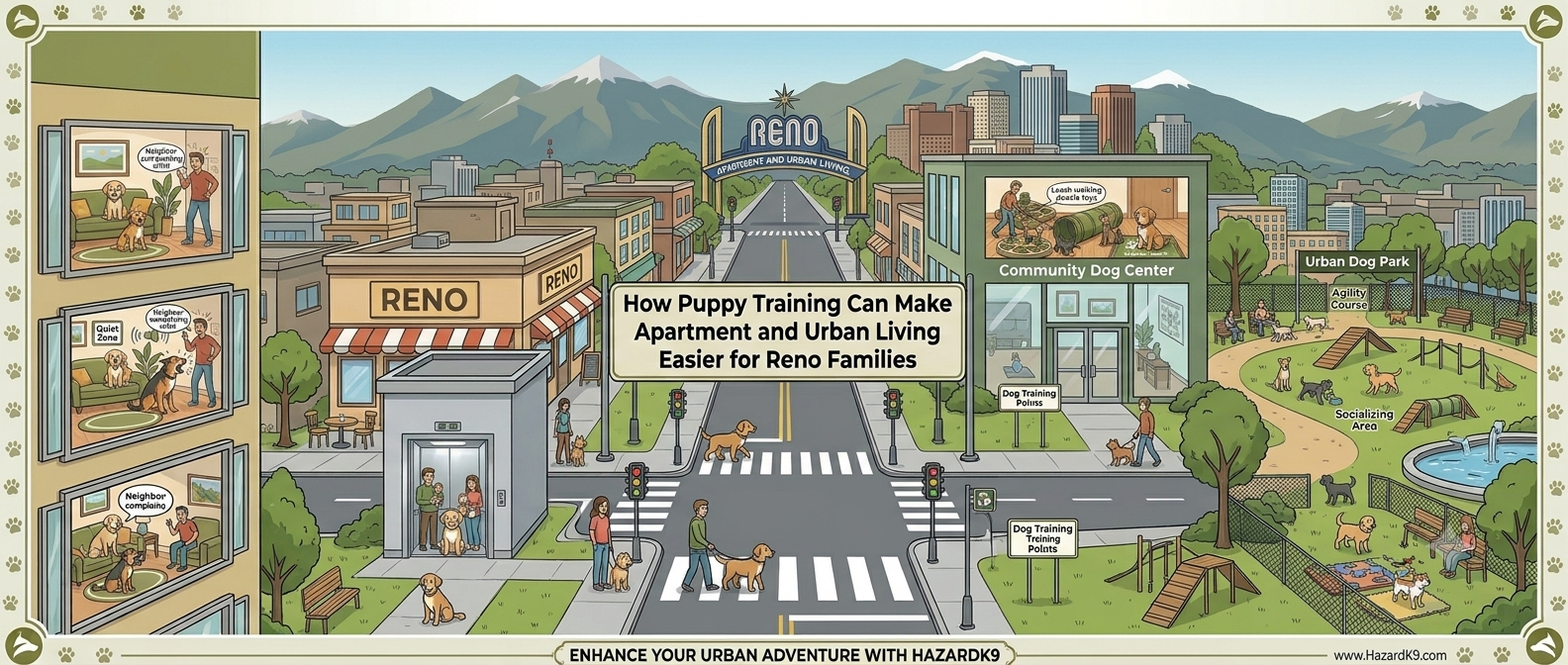
Making Urban Puppy Ownership More Manageable
Raising a puppy in an urban environment can be rewarding, but it also comes with challenges that require patience, consistency, and preparation. Reno families living in apartments or other closely connected neighborhoods may need to think carefully about how their puppy behaves around neighbors, visitors, and unfamiliar surroundings. Proper training helps puppies understand household expectations while giving owners practical tools for managing everyday situations. We believe effective training should support both the puppy’s development and the family’s lifestyle. A well-trained puppy is generally easier to handle during walks, outings, social situations, and quiet periods at home. For families adjusting to life with a young dog, early training can make the transition smoother and more enjoyable.
Teaching Puppies to Settle in Smaller Spaces
Apartments can provide comfortable homes for dogs, but limited indoor space means puppies need to learn how to settle appropriately. Young dogs naturally have energy, curiosity, and a desire to explore, which can sometimes result in jumping, chewing, barking, or constant movement. Training can teach a puppy when it is appropriate to play and when it is time to relax. Teaching commands such as place, stay, and settle can create useful routines within an apartment environment. These skills can also help puppies become more comfortable when their owners are working, cooking, relaxing, or attending to household responsibilities. Consistent training gives a puppy clear expectations without requiring a large amount of living space.
Reducing Excessive Barking
Noise can become an important concern when a family shares walls, hallways, elevators, and common areas with other residents. Puppies may bark because they hear unfamiliar sounds, see people outside a window, encounter other animals, or become excited by activity around the building. Training can help owners identify the reasons behind barking and teach more appropriate responses to common triggers. Building calm behavior through structured exercises can reduce unnecessary vocalization over time. Families can also reinforce quiet behavior so puppies learn that remaining calm is a desirable response to ordinary household and neighborhood sounds. These skills can contribute to a more peaceful home environment while helping families maintain positive relationships with their neighbors.
Improving Leash Manners Around Reno
Urban living often requires puppies to spend significant time walking through sidewalks, parking areas, residential streets, and shared outdoor spaces. A puppy that constantly pulls, jumps toward strangers, or reacts strongly to other dogs can make ordinary walks stressful for everyone involved. Leash training teaches puppies how to move alongside their handlers while paying attention to direction and pace. Practicing these skills in gradually more distracting environments can help puppies transfer their training into real-world situations. Good leash manners also provide owners with greater control when unexpected people, bicycles, vehicles, or animals appear nearby. We focus on practical obedience skills that can help make daily walks more predictable and manageable for Reno families.
Building Better Elevator and Hallway Behavior
Apartment living often exposes puppies to situations that do not occur as frequently in detached homes. Elevators, narrow hallways, stairwells, doors, and shared entrances can place dogs close to unfamiliar people and animals. Puppies that have not learned how to remain calm may become overly excited or nervous in these confined spaces. Training can teach puppies to wait at doors, remain close to their owners, and respond to basic commands before entering shared areas. Practicing these behaviors can make elevator rides, hallway encounters, and building entrances less stressful. Over time, puppies can become more confident navigating these everyday aspects of urban life.
Encouraging Positive Social Behavior
Reno families may regularly encounter other dogs and people during walks, visits to parks, outdoor activities, and neighborhood outings. Puppies need opportunities to learn how to interact appropriately without assuming that every person or dog should become a playmate. Structured training can help puppies develop impulse control and respond calmly when they encounter distractions. Teaching a puppy to look toward its handler and follow instructions can be especially useful when another dog approaches unexpectedly. Positive social experiences combined with consistent boundaries can support confidence without encouraging uncontrolled behavior. This balanced approach can help puppies become more adaptable companions in busy urban environments.
Establishing Reliable Potty Training
Potty training can require additional planning when a puppy lives in an apartment or another home without immediate access to a private yard. Owners may need to use elevators, stairs, hallways, or designated outdoor areas every time their puppy needs to go outside. Establishing a consistent schedule helps puppies understand when and where bathroom breaks are expected. Recognizing early signals and responding quickly can also reduce accidents inside the home. As puppies develop better bladder control, maintaining predictable routines can make bathroom management considerably easier. Reliable potty habits give both puppies and their families greater freedom and confidence in an apartment setting.
Teaching Puppies to Handle Being Alone
Many urban families have work, school, errands, appointments, and other responsibilities that require them to leave home temporarily. Puppies that have not learned to spend time alone may become distressed, destructive, or excessively vocal when their owners leave. Gradual training can help puppies understand that temporary separation is a normal part of daily life. Creating predictable departure and return routines can also reduce unnecessary excitement surrounding these moments. Puppies can gradually learn to relax independently while their owners are away. This skill is particularly valuable for apartment residents because excessive barking or destructive behavior can affect both the household and nearby neighbors.
Managing Energy Through Structure
Puppies require physical activity and mental stimulation, but simply allowing them to burn energy without structure does not necessarily produce better behavior. Urban families can benefit from combining walks, obedience practice, play sessions, and calm periods throughout the day. Short training exercises can provide mental challenges while reinforcing behaviors that owners want to see consistently. Teaching puppies to transition from active play into calm behavior can be especially useful in smaller homes. A structured routine also helps puppies understand what happens throughout the day and what is expected from them. We encourage families to view training as an ongoing part of daily life rather than an isolated activity.
Helping Puppies Navigate Busy Environments
Reno offers a variety of environments where puppies may encounter traffic, crowds, outdoor dining areas, trails, parks, and unfamiliar sounds. Introducing puppies to different surroundings gradually can help them become comfortable without overwhelming them. Training provides owners with communication tools that can be used when the environment becomes more stimulating. Commands such as sit, stay, come, and leave it can help owners manage situations where distractions are unavoidable. Practicing these behaviors in controlled settings before using them in busier locations can improve reliability. With consistent exposure and guidance, puppies can become better prepared for the varied experiences that come with urban living.
Preventing Destructive Household Habits
Puppies naturally investigate their surroundings with their mouths, which can result in chewing furniture, shoes, cords, household objects, or other items. In an apartment, destructive behavior can become particularly inconvenient because families often have limited storage and living space. Training combined with appropriate management can teach puppies which objects are acceptable for chewing and which should be left alone. Providing appropriate outlets for chewing and mental stimulation can reduce the temptation to investigate household possessions. Reinforcing desirable behavior helps puppies understand what their owners expect rather than relying only on corrections after unwanted behavior occurs. Early guidance can therefore protect household belongings while helping puppies develop better habits.
Creating More Confidence for Families
One of the greatest benefits of puppy training is that it can give owners greater confidence when handling everyday situations. Families who understand how to communicate clearly with their puppies are often better prepared to respond when challenges arise. Training can establish predictable routines that make feeding, walking, resting, socializing, and leaving home easier to manage. Puppies also benefit from knowing what behaviors are expected because consistent boundaries provide useful structure. At Hazard K9, we help families build practical skills that can support a stronger relationship between owners and their dogs. The result can be a more comfortable household where both the puppy and the family understand how to navigate daily life together.
Making Apartment Living More Enjoyable
Successful puppy ownership in an urban environment depends on more than having enough space for a dog to live comfortably. It requires teaching the puppy how to behave around people, animals, sounds, shared spaces, and everyday household activities. Consistent training can make common challenges such as barking, leash pulling, jumping, potty training, and separation easier to manage. Families can also use training to create routines that balance exercise, stimulation, social experiences, and relaxation. When puppies understand household expectations, owners can spend more time enjoying their companionship and less time reacting to preventable problems. For Reno families, thoughtful puppy training can be an important foundation for creating a calm, respectful, and rewarding urban lifestyle.
Building a Strong Foundation for the Future
The habits a puppy develops during its early months can influence how it behaves as it matures. Establishing reliable communication and boundaries early gives families a foundation that can continue to support their dog throughout adulthood. Urban environments can change frequently, so dogs benefit from learning how to remain responsive even when surroundings are unfamiliar. Training also gives owners a practical framework for reinforcing good behavior as their puppy grows and develops. We believe the goal is not simply to teach individual commands but to help families develop dependable communication that works in everyday situations. With the right foundation, a well-trained puppy can become a confident companion capable of adapting successfully to apartment and urban life.
