

Understanding the Foundation of Effective K9 Training
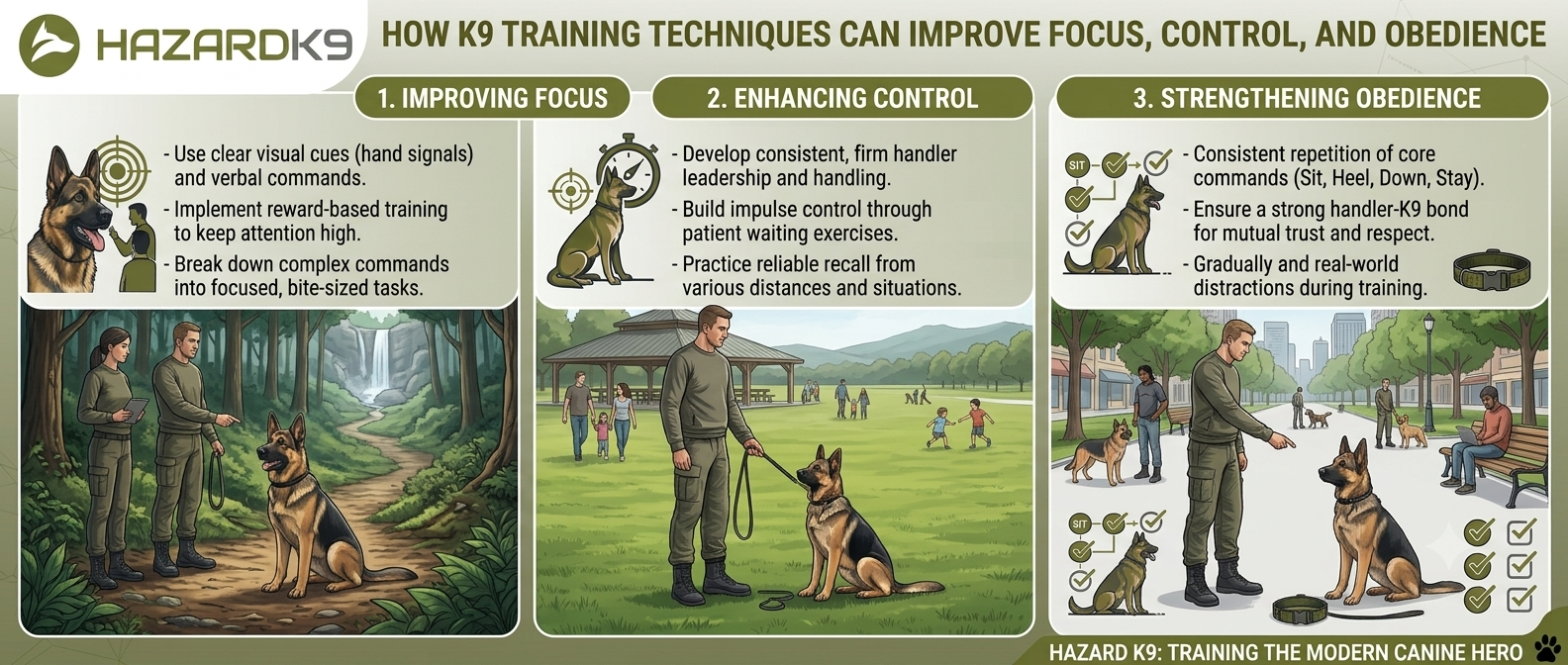
Effective K9 training is built around communication, consistency, timing, and trust between the handler and the dog. Whether a dog is being prepared for security work, detection duties, protection, or structured obedience, these fundamentals help create reliable behavior. Focus allows a K9 to concentrate on its handler and assigned task even when distractions are present. Control gives the handler the ability to guide the dog's behavior safely and confidently in different environments. Obedience provides the foundation for translating commands into dependable actions when they matter most. At Hazard K9, we understand that developing these qualities requires structured training that matches the dog's temperament, abilities, and intended role.
Building Stronger Focus Through Structured Exercises
Focus is one of the most important qualities a working K9 can develop because demanding environments often contain competing sights, sounds, smells, and movements. Training exercises can gradually teach dogs to maintain attention on their handler despite distractions. Handlers can begin with controlled environments before introducing more challenging conditions as the dog's concentration improves. Reward based reinforcement can help establish positive associations with maintaining attention and responding correctly to commands. Repetition also helps dogs understand that remaining attentive is part of the expected behavior rather than an occasional response. Over time, structured focus exercises can help create a K9 that remains engaged with its handler when distractions would otherwise interrupt its performance.
Improving Control Through Consistent Commands
Control depends heavily on clear communication between the handler and the K9. Dogs respond more reliably when commands are consistent, understandable, and reinforced through predictable training patterns. A handler should use established verbal or physical cues rather than constantly changing the signals associated with a particular behavior. Training can also teach a dog when to start an action, when to stop, and when to remain in a specific position. This level of control becomes particularly important when a working K9 must operate around people, vehicles, unfamiliar environments, or other animals. Consistent practice allows the dog to develop reliable responses while helping the handler become more precise and confident.
Developing Reliable Obedience
Obedience training teaches a K9 to respond appropriately to established commands and expectations. Basic behaviors such as sitting, staying, coming when called, and maintaining position provide important building blocks for more advanced training. Once these behaviors become dependable, handlers can gradually introduce greater distances, longer durations, and additional distractions. The objective is not simply to make a dog perform commands during a controlled training session. Instead, effective obedience training aims to create dependable responses that remain available when the surrounding environment becomes more challenging. This reliability gives handlers greater confidence that their K9 will respond appropriately when a situation requires immediate direction.
Using Positive Reinforcement Effectively
Positive reinforcement can play an important role in developing behaviors that trainers want K9s to repeat consistently. Rewards may include food, toys, praise, play, or other forms of reinforcement that the individual dog finds motivating. The timing of reinforcement matters because the dog needs to connect the reward with the behavior that earned it. Trainers can gradually reduce the frequency of rewards as behaviors become more established while continuing to provide meaningful reinforcement when appropriate. This approach can help maintain motivation without making the dog dependent on receiving a reward after every successful response. When applied thoughtfully, positive reinforcement can strengthen communication and make training sessions more productive.
Teaching Dogs to Work Around Distractions
A K9 may demonstrate excellent obedience in a quiet training environment but struggle when exposed to unfamiliar distractions. Effective training therefore needs to introduce distractions gradually and in a controlled manner. Trainers can increase environmental difficulty by incorporating unfamiliar sounds, people, surfaces, movements, scents, and locations. The dog learns that its handler's commands remain relevant even when something more exciting or unfamiliar is happening nearby. Progress should be measured carefully so that distractions challenge the dog without creating unnecessary confusion or stress. This gradual approach can help build the concentration and composure required for dependable performance in real world situations.
Strengthening the Handler and K9 Relationship
Successful K9 training depends on more than teaching commands because the relationship between the handler and dog directly influences communication. A dog that understands its handler's expectations can respond more confidently and consistently during training and operational situations. Handlers also need to learn how their timing, body language, voice, and positioning influence canine behavior. Training together allows both partners to recognize patterns and correct communication problems before they become significant issues. Trust develops when the handler provides consistent guidance and the dog receives clear expectations and appropriate reinforcement. A strong handler and K9 relationship can therefore become one of the most valuable foundations for focus, control, and obedience.
Maintaining Discipline Through Repetition
Dogs learn through repetition, which makes consistent practice an essential part of long term K9 development. A behavior that is performed successfully once may not become dependable without continued reinforcement and exposure to different situations. Regular training helps maintain previously established commands while giving handlers opportunities to identify areas that require additional work. Short, focused sessions can often be more productive than repetitive exercises that cause the dog to lose engagement. Training should also evolve as the dog's skills improve so that established behaviors continue to be challenged appropriately. With consistent practice, obedience can become a dependable part of the dog's normal behavioral response rather than something demonstrated only during formal sessions.
Increasing Confidence Through Progressive Training
Confidence can influence how effectively a K9 responds to commands and navigates unfamiliar situations. Dogs that are gradually introduced to new environments can learn to approach unfamiliar circumstances without immediately becoming distracted or overwhelmed. Trainers can use controlled exposure to different surfaces, sounds, locations, equipment, and scenarios to build adaptability. Each successful experience provides an opportunity for the dog to learn that unfamiliar situations can be managed through established behaviors and handler guidance. Confidence should be developed progressively because pushing a dog too quickly can interfere with learning and engagement. A balanced training program can therefore improve both obedience and the dog's ability to remain composed when conditions change.
Applying Obedience to Specialized K9 Work
Advanced K9 roles require more than basic obedience because working dogs may need to perform specialized tasks under demanding conditions. Detection, patrol, protection, search, and other operational roles can require precise responses and strong environmental awareness. Basic obedience provides the communication framework that allows specialized behaviors to be developed safely and consistently. A K9 that can maintain position, respond to commands, disengage from distractions, and remain focused is better prepared for advanced training. Specialized exercises should be introduced according to the dog's role, capabilities, and training objectives rather than using the same approach for every K9. This individualized progression helps ensure that obedience supports the dog's specific operational responsibilities.
The Importance of Handler Consistency
Even highly capable dogs can become inconsistent when handlers provide conflicting expectations. Everyone involved in a K9's training should understand the commands, reinforcement methods, boundaries, and behavioral expectations being established. Consistency helps prevent a dog from receiving one response for a behavior in one situation and a completely different response in another. Handlers should also pay attention to their own timing because delayed corrections or rewards can make it difficult for the dog to understand which behavior is being reinforced. Clear communication allows training sessions to remain predictable and easier for the dog to understand. Strong handler consistency ultimately helps transform individual exercises into reliable habits.
Measuring Progress Over Time
K9 training should be evaluated through observable improvements rather than assumptions about progress. Trainers can monitor response time, command reliability, distraction tolerance, positioning, engagement, and the dog's ability to maintain learned behaviors in different environments. Tracking these areas makes it easier to identify strengths and determine where additional practice is needed. Progress should also consider the individual dog's temperament, age, experience, motivation, and intended working role. Some dogs may advance quickly in one area while requiring additional development in another. Regular assessment helps trainers adjust their methods so that training remains challenging, productive, and appropriate for the K9.
Creating Long Term Reliability
The ultimate purpose of effective K9 training is to develop reliable behavior that can be maintained beyond individual training sessions. Focus, control, and obedience become more valuable when they remain dependable across different environments and levels of distraction. This requires continued reinforcement, consistent handling, appropriate challenges, and regular evaluation of performance. Training should not stop simply because a dog has mastered a particular command or completed a formal program. Continued development helps maintain learned behaviors while allowing the K9 to adapt as responsibilities and environments change. At Hazard K9, we recognize that long term reliability comes from treating training as an ongoing process rather than a single event.
Building Better Working Partnerships
A well trained K9 can provide significant value when its skills are matched with a knowledgeable and consistent handler. Focus helps the dog stay engaged, control allows the handler to direct behavior, and obedience creates dependable responses to established commands. Together, these qualities form the foundation for effective teamwork in both training and operational environments. The strongest results come from structured methods that respect the individual dog's abilities while maintaining clear expectations. When training is approached patiently and consistently, dogs can develop stronger behavioral reliability and handlers can gain greater confidence in their communication. The result is a more disciplined working partnership built on clear guidance, trust, repetition, and purposeful training.
