

Desert-to-Urban Reliability Training System for Working Dogs in Reno’s Climate Gradient
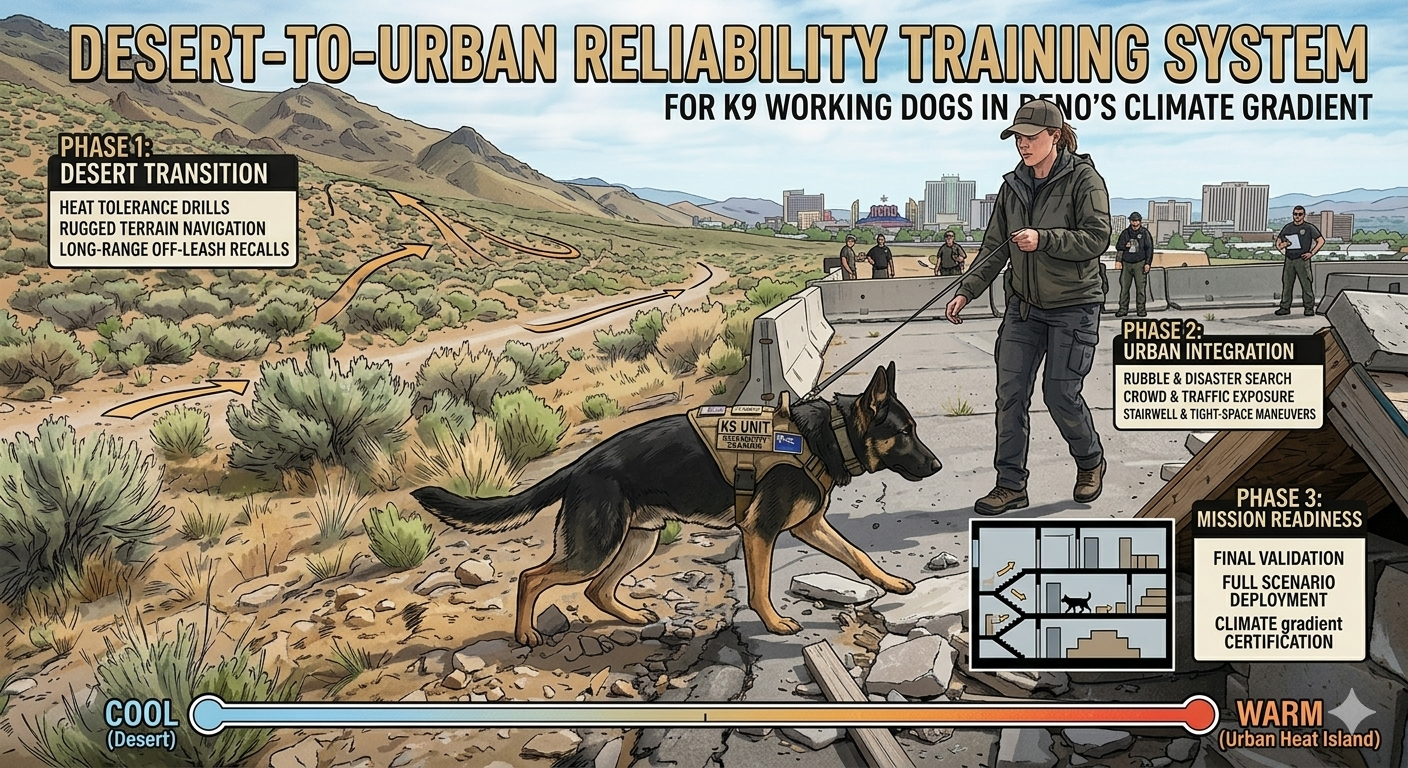
Desert-to-Urban Reliability Training System for Working Dogs in Reno’s Climate Gradient
Training a reliable working dog is not just about obedience in controlled environments. It is about building decision-making stability across shifting terrains, temperatures, and distractions. In Reno, the environment itself becomes a training variable, with dry desert air, sudden wind shifts, urban congestion, and high sensory stimulation creating a uniquely demanding setting for canine development.
We design our programs around one core principle: a dog that performs only in the training room is not truly trained. Real-world reliability requires structured exposure, progressive stress conditioning, and behavior reinforcement under varied environmental loads. This is the foundation of our approach at Hazard K9.
Understanding Reno’s Environmental Training Complexity
Reno presents a hybrid training landscape that blends urban density with desert expanses. This combination creates a rare opportunity for behavioral conditioning but also introduces challenges that must be carefully managed.
Key environmental factors include:
• Low humidity and dry air that can affect endurance and recovery cycles
• High temperature variance between morning and evening sessions
• Strong wind patterns that introduce scent and auditory disruption
• Urban distractions such as traffic, pedestrians, and public spaces
• Open terrain that encourages prey drive activation in working breeds
These variables require dogs to generalize commands rather than memorize location-specific obedience patterns.
The Desert-to-Urban Reliability Methodology
Our system is built around staged environmental layering. Instead of teaching commands in isolation, we integrate them into progressively complex scenarios.
We focus on three core phases:
1. Controlled Baseline Conditioning
Dogs are first stabilized in low-distraction environments. We reinforce core obedience, recall precision, and handler engagement. The objective is not speed but clarity of response under minimal pressure.
2. Transitional Stress Introduction
Next, we introduce controlled distractions such as movement, sound variation, and scent interference. Dogs begin learning to maintain cognitive focus even when environmental stimuli compete for attention.
3. Real-World Integration Training
Finally, dogs operate in mixed environments that replicate real-world unpredictability. This includes urban streets, open terrain, and transitional zones where stimuli shift rapidly.
This methodology ensures behavioral consistency rather than situational obedience.
Core Program Modules
Our training structure is divided into specialized modules that target both instinctual and learned behaviors.
Impulse Control Conditioning
Dogs learn to suppress immediate reactions in favor of handler-driven commands. This is essential for working breeds with high prey or protection drive.
Environmental Neutrality Training
We condition dogs to treat background stimuli as irrelevant unless explicitly directed otherwise by the handler.
Advanced Recall Under Load
Recall is tested across distance, distraction levels, and terrain variation to ensure reliability even in high-arousal states.
Handler Communication Synchronization
We refine timing, tone recognition, and body language interpretation to create a seamless communication loop between handler and dog.
Why Structured Environmental Training Matters
Without structured exposure, dogs often develop context-dependent obedience. This means they perform well in familiar spaces but degrade in new environments.
Our approach prevents that breakdown by ensuring behavior is generalized across conditions. At Hazard K9, we prioritize adaptability over rote performance.
This is particularly important in regions like Reno, where environmental conditions can shift rapidly within a single training session.
________________________________________
Expected Outcomes
Dogs completing this system typically demonstrate:
• Stable obedience across high-distraction environments
• Improved decision latency under pressure
• Reduced reactivity to environmental triggers
• Stronger handler engagement in off-leash scenarios
• Increased endurance in outdoor operational contexts
These outcomes are not achieved through repetition alone but through structured environmental adaptation.
Reliable working dog performance requires more than command repetition. It requires systematic exposure to real-world complexity and disciplined behavioral shaping across environments.
Hazard K9 focuses on building dogs that remain responsive, controlled, and predictable regardless of setting. Through layered environmental conditioning in Reno, we create working dogs capable of consistent performance under real operational conditions.
Hazard K9 remains committed to advancing training systems that prioritize adaptability, clarity, and real-world reliability.
