

High-Desert Cognitive Conditioning: A Reno-Specific Approach to Reliable Dog Training
High-Desert Cognitive Conditioning: A Reno-Specific Approach to Reliable Dog Training
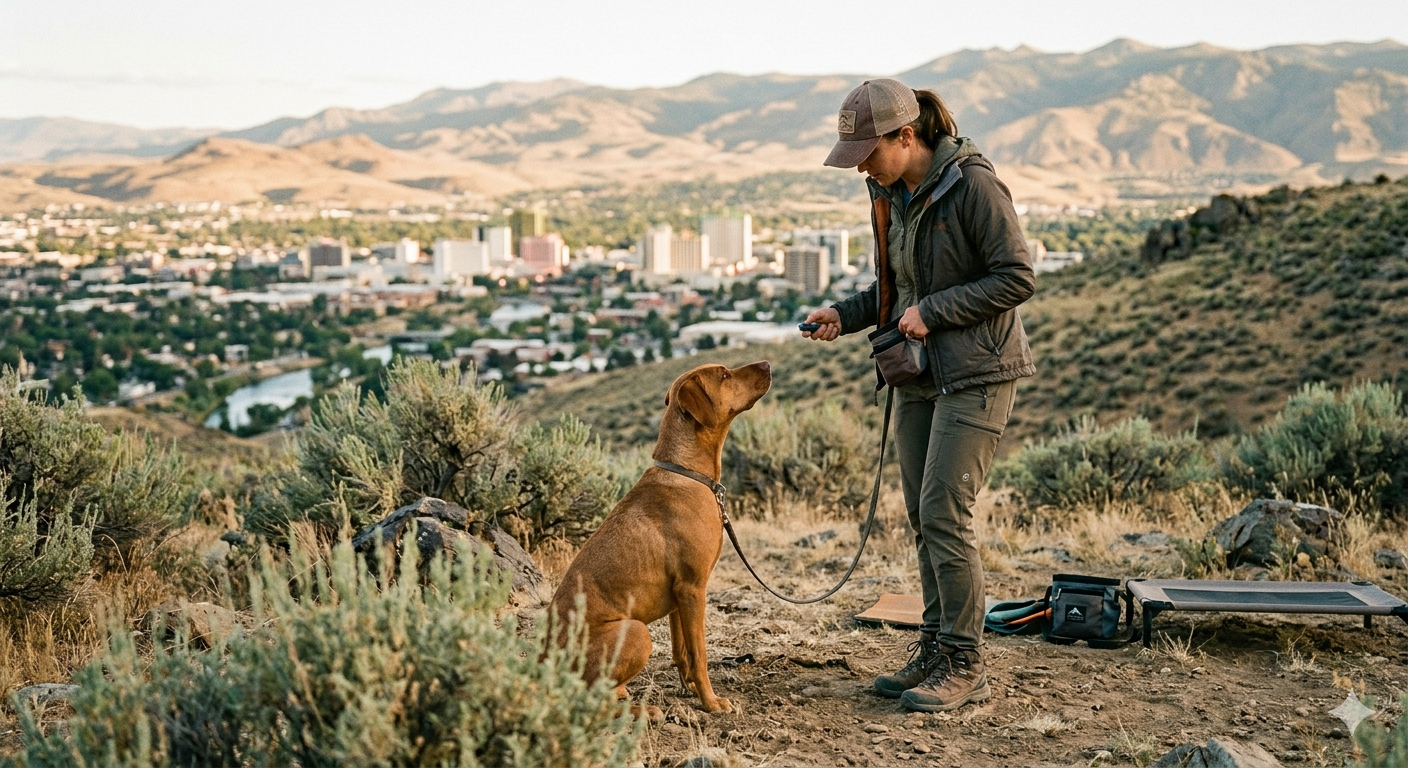
Reno is not a generic training environment. It is a high-desert ecosystem defined by sudden weather shifts, arid terrain, intense sunlight, and a mix of dense urban pockets surrounded by open wilderness. These conditions create a very specific behavioral landscape for dogs, one where distraction, stimulation, and environmental variability are constant.
At our dog training school in Reno, we do not treat behavior as something that exists in isolation. We treat it as something shaped by climate, geography, and daily exposure. This approach is what we call high-desert cognitive conditioning, a structured method that builds reliable behavior through environmental adaptation rather than artificial repetition in controlled indoor settings.
The result is not just obedience. It is stability, clarity, and responsiveness in real-world conditions that dogs in this region actually live in.
Why Reno Requires a Different Training Philosophy
Most traditional dog training systems were designed for temperate, predictable environments. Reno is not predictable.
A single walk can expose a dog to:
• Dry, wind-heavy terrain that carries scent rapidly
• Sudden wildlife encounters on suburban edges
• High pedestrian density in downtown zones
• Extreme heat in summer and reflective glare from urban surfaces
• Off-leash dogs in open recreational areas
• Rapid transitions between quiet residential streets and loud commercial zones
This constant variation creates what we refer to as environmental volatility. Dogs trained only in controlled environments often struggle when these variables appear simultaneously.
Our philosophy is simple. If behavior is expected in the real world, it must be trained in conditions that resemble the real world.
The Core Principle: Cognitive Load Management
At the center of our methodology is cognitive load management. This refers to how much mental processing a dog can handle while still maintaining obedience, focus, and emotional control.
In Reno, cognitive load increases quickly because of competing stimuli. A dog may need to process:
• Movement in peripheral vision
• Unfamiliar scents carried by wind
• Human and vehicle noise overlap
• Temperature stress
• Handler commands
When overload occurs, behavior breaks down. Pulling, reactivity, ignoring recall, and hypervigilance are all symptoms of exceeding cognitive capacity.
We design training programs that gradually expand this capacity rather than forcing immediate compliance. This creates stable behavior under stress, not just performance under ideal conditions.
Environmental Conditioning: Training Beyond the Facility
A major distinction in our approach is the removal of over-reliance on static training environments.
Instead of teaching commands only in controlled spaces, we integrate environmental progression stages:
Stage 1: Controlled Clarity
We establish foundational communication patterns in low-distraction environments. The focus is precision, not intensity.
Stage 2: Variable Introduction
We introduce mild distractions such as movement, moderate sound, and scent variation while reinforcing responsiveness.
Stage 3: Environmental Stress Testing
Training shifts into real Reno environments including parks, sidewalks, and transitional zones where unpredictability is present.
Stage 4: Generalization Across Contexts
Commands are reinforced across multiple unrelated environments so the dog does not associate obedience with a single location.
This progression ensures that behavior is not context-dependent.
Addressing Common Behavioral Issues in Reno Dogs
Because of the region’s environmental structure, we see recurring behavioral patterns in dogs that come to training programs.
1. Overarousal in Open Spaces
Many dogs become overstimulated in wide-open desert areas or large parks. Without boundaries, they experience sensory overload and lose responsiveness.
We address this by building structured freedom, where off-leash time is earned through demonstrated control rather than assumed.
2. Barrier Reactivity
Dogs often react strongly to fences, windows, or leashes because they feel restricted while still exposed to external stimuli.
We reduce this by conditioning neutrality to boundaries, teaching the dog that barriers do not require emotional response.
3. Inconsistent Recall Behavior
Recall failure is often not a command issue but a value hierarchy issue. The environment becomes more rewarding than the handler.
We rebuild engagement value through structured reinforcement systems that operate even in high-distraction environments.
4. Heat and Fatigue Sensitivity
Reno’s climate introduces physical stress that directly affects behavior. A fatigued dog is not a disobedient dog, but a cognitively depleted one.
We incorporate environmental pacing and conditioning so physical stress does not interrupt behavioral reliability.
Communication Architecture: Building a Shared Language
Training is fundamentally a communication system. We structure this system into three layers:
Primary Signals
These are core commands such as recall, sit, place, and heel. They must remain consistent regardless of environment.
Secondary Markers
These include reward markers and correction indicators that help the dog understand outcomes quickly.
Contextual Cues
These are environmental signals that the dog learns to interpret, such as leash tension, body orientation, and spatial positioning.
By aligning these layers, we reduce ambiguity and increase decision speed in the dog’s response cycle.
Behavioral Stability Over Obedience Performance
A key misconception in dog training is that obedience equals reliability. In reality, obedience in isolation is fragile.
We prioritize behavioral stability, which means:
• The dog maintains composure under distraction
• The dog self-regulates in stimulating environments
• The dog responds consistently across different handlers and locations
• The dog recovers quickly from errors or surprises
This is particularly important in Reno, where environmental variability is constant and unpredictable.
The Role of Handler Psychology
Dog behavior is strongly influenced by handler state. Inconsistent energy, unclear expectations, or emotional escalation often leads to unstable responses.
We train handlers to:
• Deliver commands with neutral consistency
• Avoid reinforcement of reactive states
• Maintain predictable interaction patterns
• Recognize early signs of cognitive overload in the dog
A well-trained dog is often the reflection of a well-calibrated handler.
Long-Term Training Outcomes
Our goal is not temporary compliance. It is durable behavioral architecture that remains stable over time.
Dogs that complete structured high-desert conditioning typically show:
• Strong recall reliability in open environments
• Reduced reactivity to environmental triggers
• Improved leash neutrality and walking structure
• Faster recovery from stress events
• Higher engagement with handlers in distracting contexts
These outcomes are not achieved through repetition alone but through progressive environmental adaptation.
A Structured Approach to Real-World Dogs
Modern dogs do not live in training rooms. They live in neighborhoods, parks, trails, and social environments filled with unpredictability.
That is why our approach is built around real-world relevance rather than artificial perfection. We focus on how dogs behave when life is not controlled, because that is the only time behavior truly matters.
Dog training in Reno requires more than obedience instruction. It requires an understanding of environment, cognition, and behavioral adaptation under stress. By treating the high-desert environment as an active part of the learning process, we build dogs that are not only trained but genuinely reliable in the world they actually inhabit.
Hazard K9 applies this philosophy through structured progression, environmental conditioning, and cognitive load management.
