

Why Long-Line Training Often Comes Before Genuine Off-Leash Reliability
Understanding the Purpose of Long-Line Training
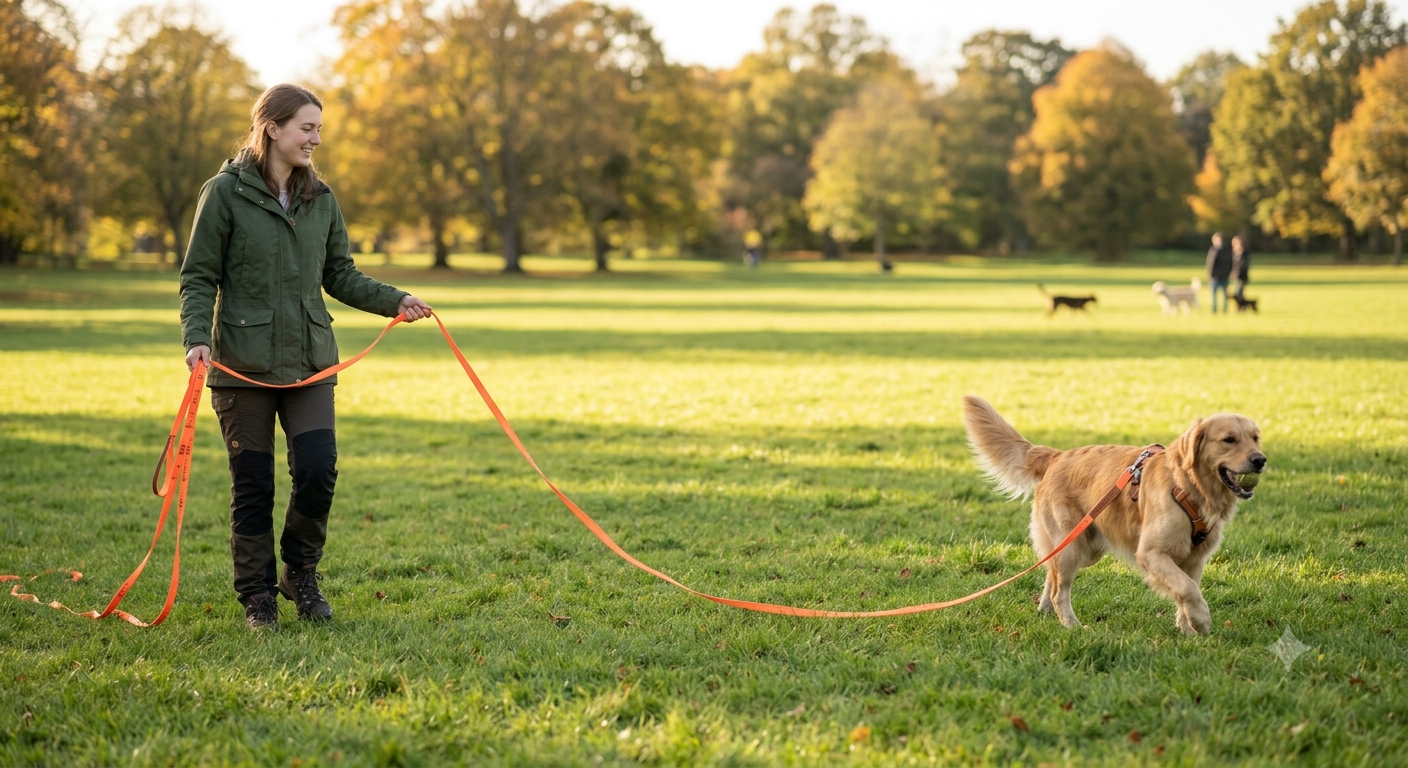
Off-leash reliability is one of the most rewarding milestones a dog and handler can achieve, but it should rarely be treated as a starting point. A dog may appear obedient in a familiar backyard while responding very differently when confronted with wildlife, unfamiliar dogs, new people, traffic sounds, or an exciting outdoor environment. This is why long-line training often plays an important transitional role between basic obedience and dependable off-leash control. A long line provides the dog with meaningful freedom while allowing the handler to maintain a practical level of control when necessary. At Hazard K9, we use this stage to help build communication, responsiveness, confidence, and consistency without immediately removing every safety margin. The objective is not simply to keep a dog attached to a long line, but to gradually teach the dog how to make reliable choices when greater freedom is available.
Why Immediate Off-Leash Freedom Can Be Misleading
Many owners assume that if a dog understands commands such as recall, sit, stay, or place inside the home, those behaviours should automatically transfer to an off-leash environment. In reality, obedience is highly influenced by context, distractions, reinforcement history, arousal levels, and the dog's understanding of expectations. A dog that responds perfectly in a quiet room may hesitate when a rabbit suddenly crosses its path or another dog begins running nearby. Off-leash environments introduce competing motivations that can expose weaknesses that are invisible during controlled obedience sessions. Giving unrestricted freedom before those weaknesses have been addressed can create situations in which the handler has no effective way to interrupt an unwanted decision. Long-line work helps reveal those gaps while still providing a physical connection that can prevent a mistake from becoming a dangerous incident.
Building Reliable Recall Through Distance
Recall is one of the most important behaviours associated with responsible off-leash freedom, and reliability must be developed rather than assumed. A dog needs to learn that coming back to its handler remains valuable even when something more interesting is happening elsewhere. Long-line exercises allow handlers to gradually increase distance while continuing to reinforce successful responses. The line can provide additional control when the dog hesitates, becomes distracted, or begins moving away from the desired area. This creates opportunities to practise recall repeatedly in realistic environments without requiring the handler to gamble on whether the dog will respond. With consistent training, the dog can begin to understand that returning to the handler is a dependable behavioural expectation rather than an optional suggestion.
Increasing Freedom Without Losing Structure
One of the most useful characteristics of long-line training is that it allows freedom to increase progressively. A dog can move, sniff, investigate, explore its surroundings, and experience environmental stimulation without immediately being placed in a completely unrestricted situation. This balance can make training more realistic because the dog is not simply practising obedience while standing beside the handler. At the same time, the handler retains the ability to manage distance and prevent the dog from rehearsing behaviours that could undermine future reliability. We view this process as controlled freedom, where the dog receives more independence as its decision-making becomes more dependable. The transition toward off-leash work therefore becomes a measured progression rather than a sudden change.
Testing Behaviour Around Real Distractions
A dog cannot be considered genuinely reliable if it only performs when there are no meaningful distractions. Real-world environments contain sounds, smells, movement, animals, people, vehicles, and countless other stimuli that can compete for a dog's attention. Long-line training allows handlers to introduce these distractions gradually while preserving enough control to respond if the dog makes an incorrect choice. This can help identify specific triggers that require additional training before off-leash freedom becomes appropriate. A dog that ignores its handler when another dog appears may need a different level of preparation from a dog that loses focus when it sees wildlife. By systematically exposing the dog to increasingly difficult situations, training can develop reliability under conditions that more closely resemble everyday life.
Teaching the Dog to Make Better Choices
True off-leash reliability is not simply about forcing a dog to remain close to its handler. It involves developing a history of appropriate decisions in which the dog learns that responding to the handler produces worthwhile outcomes. Long-line training gives the dog opportunities to practise those decisions while the handler maintains a safety mechanism. When the dog chooses to return, disengage from a distraction, or remain within an appropriate area, that behaviour can be reinforced. Repetition helps transform individual successful responses into more predictable habits. Over time, the dog can begin to demonstrate greater self-control even when the handler is not constantly providing direct physical guidance
Managing Distance and Environmental Pressure
Distance changes the difficulty of many behaviours, particularly recall and attention. A dog that responds instantly when standing a few feet away may need substantially more training when it is several dozen feet from its handler. Environmental pressure can also increase as distance grows because the dog has more opportunities to investigate and encounter competing stimuli. Long-line training provides a structured way to increase distance without making the consequences of failure unnecessarily severe. We can gradually determine how far a dog can work successfully before increasing the challenge further. This measured progression helps establish realistic expectations and reduces the temptation to confuse physical proximity with genuine reliability.
Preventing the Rehearsal of Unwanted Behaviour
Every time a dog successfully runs away after ignoring a recall, chases an animal, approaches someone without permission, or engages in another unwanted behaviour, that experience can influence future choices. Unwanted behaviours may become more difficult to address when the dog repeatedly discovers that ignoring the handler produces access to something rewarding. A long line can help reduce these opportunities while training is still developing. It provides the handler with a practical way to interrupt an unsafe direction of travel and redirect the dog toward a more appropriate response. This does not replace training or reinforcement, but it can help prevent repeated rehearsal while reliability is being built. The goal is to create more opportunities for successful behaviour than for uncontrolled mistakes.
The Difference Between Obedience and Reliability
Obedience and reliability are related, but they are not identical concepts. A dog may know what a command means while still failing to perform it consistently under high distraction or emotional arousal. Reliability requires the behaviour to remain functional across different locations, distances, distractions, and levels of excitement. Long-line training helps bridge this gap by taking familiar behaviours into increasingly challenging environments. The handler can observe whether the dog understands the expectation when circumstances become more complicated. This distinction is particularly important when off-leash freedom could expose the dog to hazards that cannot be controlled through verbal commands alone.
Developing Handler Timing and Communication
Long-line training also benefits the human side of the training relationship. Handlers need to learn how to recognize changes in their dog's attention, body language, arousal, and environmental focus. They must also develop appropriate timing when giving cues, reinforcing desirable behaviour, and responding to unwanted movement. Working with a long line can help handlers become more aware of how distance and distractions influence their dog's responsiveness. This awareness becomes increasingly valuable as the dog receives more freedom. We believe reliable off-leash work depends not only on the dog's skills, but also on the handler's ability to communicate clearly and make appropriate decisions in changing environments.
Progressing From Long Line to Off-Leash Work
The transition away from a long line should happen because the dog's behaviour demonstrates readiness, not simply because a certain amount of time has passed. Some dogs may progress quickly in low-distraction environments while requiring significantly more preparation around wildlife, other dogs, or unfamiliar locations. Training should therefore consider the individual dog's temperament, history, motivation, responsiveness, and environment. A useful progression may involve working with increasing distance, changing locations, introducing distractions, and gradually reducing physical dependence on the line. Successful repetitions should build confidence for both the dog and handler before more freedom is introduced. This approach allows off-leash training to become the natural continuation of reliable behaviour rather than a test the dog has been unexpectedly asked to pass.
Knowing When Off-Leash Reliability Is Not Yet Ready
There are times when the correct training decision is to continue using a long line rather than move to complete freedom. A dog that frequently ignores recall, becomes highly reactive, chases wildlife, or loses awareness of its handler may require more preparation. Environmental risks must also be considered because an otherwise well-trained dog can encounter circumstances that exceed its current level of reliability. Weather, terrain, wildlife activity, unfamiliar dogs, crowded areas, and nearby roads can all change the difficulty of an environment. Responsible handling means evaluating these factors rather than assuming that previous success guarantees future success. Continuing structured long-line work is not a sign that training has failed, but often an indication that the handler is taking reliability and safety seriously.
Building Confidence Through Controlled Freedom
Confidence can be an important part of the transition toward greater independence. Dogs need opportunities to explore their surroundings and experience different environments while still understanding how to reconnect with their handlers. A long line can create that opportunity without requiring complete physical independence immediately. The dog can investigate, move away, return, and respond to cues within a structured framework. This can help create a more balanced relationship between freedom and responsibility. As successful experiences accumulate, the dog may become increasingly comfortable operating at a distance while maintaining awareness of the person handling the line.
Why Patience Produces Better Results
Reliable off-leash behaviour is generally the result of repeated practice rather than a single breakthrough session. Rushing the process can create unnecessary setbacks if the dog is given more freedom than its current skills can support. Long-line training provides a practical middle ground that allows progress without requiring the handler to choose between restrictive close control and unrestricted freedom. We focus on developing behaviours that remain useful when the environment becomes more challenging, rather than simply producing impressive responses in easy situations. Patience also gives handlers time to understand their dog's individual strengths and limitations. The more thoroughly these skills are developed before full off-leash freedom, the stronger the foundation can be for safe and dependable performance.
Creating Genuine Off-Leash Reliability
Genuine off-leash reliability is ultimately about trust supported by demonstrated behaviour. The goal is for the handler to have confidence that the dog will respond appropriately even when there is distance, movement, distraction, and competing motivation. Long-line training helps establish that confidence by providing a controlled environment in which mistakes can be managed and correct decisions can be reinforced. It gives the dog practical experience with freedom while preserving an important layer of control during the learning process. At Hazard K9, we see the long line not as a restriction that delays freedom, but as a training tool that can help make greater freedom safer and more meaningful. When the transition to off-leash work is based on consistent performance rather than optimism, both the dog and handler are better positioned for success.
Long-line training often comes before genuine off-leash reliability because freedom should be earned through demonstrated consistency rather than assumed from basic obedience. It allows dogs to experience realistic environments, increasing distance, distractions, and independence while giving handlers a practical means of maintaining control. The process can strengthen recall, improve decision-making, reduce unwanted rehearsal, and develop better communication between dog and handler. It also provides valuable information about the situations in which a dog is ready to progress and the circumstances that still require additional preparation. Off-leash reliability should ultimately represent the result of careful training, appropriate progression, and sound judgment rather than a simple removal of equipment. With a structured approach and sufficient patience, long-line work can become an important bridge between controlled obedience and dependable real-world freedom.
