

Why Reno's Open Desert Terrain Creates Unique Challenges for Off-Leash Dog Training
Why Reno's Open Desert Terrain Creates Unique Challenges for Off-Leash Dog Training
Off-leash dog training can provide dogs with an incredible sense of freedom while giving owners greater confidence in their ability to manage behavior without constant physical restraint. However, successful off-leash reliability requires much more than teaching a dog to come when called in a quiet backyard or controlled park. The environment plays a significant role in determining how well a dog responds to commands, distractions, and unexpected situations. Reno presents a particularly unique training environment because of its expansive desert terrain, open spaces, changing weather conditions, wildlife, and unpredictable distractions. While these landscapes can be beautiful and enjoyable for outdoor activities, they can also make off-leash training considerably more challenging. Dogs experience a level of sensory stimulation in open desert environments that cannot always be replicated in a traditional training facility. Understanding these environmental challenges helps owners appreciate why advanced off-leash obedience requires structured preparation, progressive exposure, and consistent reinforcement.
The Illusion of Unlimited Space
One of the most challenging aspects of Reno's desert environment is the enormous amount of open space available to an off-leash dog. At first glance, wide-open terrain may seem easier for training because there are fewer buildings, vehicles, and crowded sidewalks to navigate. In reality, unlimited space can encourage dogs to travel farther and become increasingly confident about ignoring their handler. A dog that sees a large open field may interpret the environment as an invitation to explore rather than a location where obedience expectations still apply. Without physical boundaries, dogs can quickly increase their distance from their owners and make recall commands more difficult to enforce. The greater the distance between a dog and its handler, the more competing distractions can interfere with communication. Effective training must therefore teach dogs that freedom does not eliminate responsibility and that commands remain important regardless of how much open space surrounds them.
Wildlife Creates Powerful Natural Distractions
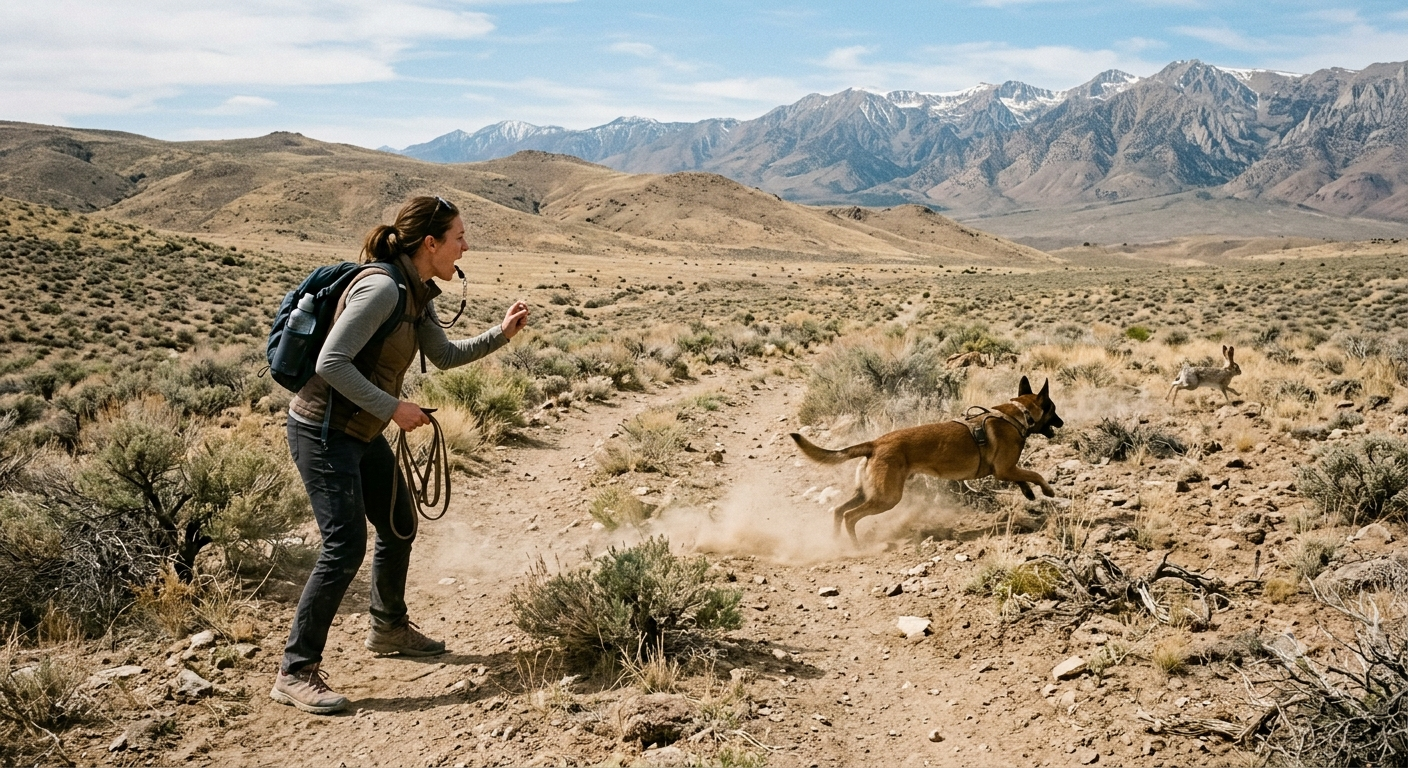
Desert terrain around Reno can expose dogs to wildlife scents, movement, and sounds that immediately activate natural instincts. Even a normally obedient dog may become highly excited when it detects the scent of a rabbit, bird, squirrel, or other animal moving through nearby terrain. Prey drive can become particularly challenging because the dog's attention may shift rapidly from the owner to the moving target. Once a dog begins chasing wildlife, distance can increase within seconds and verbal commands may become significantly less effective. This is why off-leash reliability must be developed under progressively increasing levels of distraction rather than assuming obedience learned indoors will automatically transfer outdoors. Dogs need to practice making the correct behavioral choices when exciting environmental triggers are present. At Hazard K9, we focus on developing clear communication and dependable obedience so dogs learn to respond even when the outdoor environment becomes highly stimulating.
Wind and Weather Can Affect Communication
Reno's climate can introduce additional complications that owners may not immediately consider when beginning off-leash training. Strong winds can carry scents across long distances, allowing dogs to detect interesting smells that would otherwise remain outside their awareness. Wind can also interfere with verbal communication by reducing the clarity and consistency of commands delivered from a distance. Sudden changes in temperature may affect a dog's energy level, focus, and willingness to remain engaged during longer training sessions. Hot ground conditions can create discomfort, while colder weather can change how long a dog remains comfortable outdoors. Weather conditions can also influence the presence and movement of wildlife, creating different distractions from one day to another. A truly reliable off-leash dog must learn to respond consistently despite environmental changes rather than performing well only under ideal conditions.
Uneven Ground Creates Safety and Control Concerns
Open desert terrain is rarely as flat and predictable as a manicured training field. Dogs may encounter loose rocks, uneven surfaces, dry washes, steep slopes, and hidden obstacles while moving quickly through natural areas. These conditions can create physical safety concerns, especially when an excited dog is running at full speed without paying attention to its surroundings. Uneven terrain can also make it difficult for an owner to maintain visual contact with a dog that moves behind hills, brush, or natural formations. A dog that disappears from sight for even a short period can quickly travel farther than expected. Training in these environments requires dogs to develop stronger awareness of their handler and better responsiveness to directional commands. Controlled progression is essential because allowing a dog unrestricted freedom before establishing reliable communication can create unnecessary risks.
Scents Can Be More Distracting Than What Owners Can See
Dogs experience outdoor environments primarily through scent, which means the desert landscape can provide an incredibly complex sensory experience. What appears to be an empty stretch of land to a person may contain countless scent trails from wildlife, other dogs, people, and environmental activity. A dog may suddenly become intensely interested in an area without the owner understanding what caused the behavioral change. These scent distractions can pull attention away from commands and encourage dogs to wander farther from their handlers. Because scent can travel and change with wind conditions, distractions may appear unexpectedly during an otherwise calm training session. Successful off-leash training teaches dogs to acknowledge environmental information without becoming completely consumed by it. We work to build engagement that allows dogs to enjoy their surroundings while maintaining awareness of the person responsible for guiding them.
Distance Makes Recall More Difficult
Recall is one of the most important components of off-leash obedience, but it becomes increasingly difficult as distance and distraction increase simultaneously. A dog may respond perfectly when standing ten feet away but hesitate when exploring hundreds of feet from its owner. Open terrain allows dogs to build momentum as they move away, and that momentum can make turning back less appealing than continuing to explore. Dogs may also learn that returning to their owner consistently results in the end of outdoor freedom, which can weaken their enthusiasm for recall commands. Effective training must therefore create positive and meaningful reasons for dogs to respond immediately when called. Recall should become a deeply conditioned behavior that remains dependable even when the dog is engaged with scents, movement, or environmental exploration. Building this level of reliability takes repetition, appropriate timing, and carefully structured exposure to increasingly difficult situations.
Visibility Can Change Faster Than Expected
Although desert environments appear open, visibility can change quickly depending on terrain and natural features. Small hills, brush, rocks, washes, and elevation changes can temporarily block an owner's view of a dog. A dog moving behind a natural obstacle may continue traveling while the handler loses the ability to monitor its direction or behavior. This creates a challenge because owners cannot rely exclusively on visual supervision when allowing dogs greater freedom. Dogs need to understand that maintaining an appropriate relationship with their handler is part of off-leash behavior. Training can establish patterns where dogs naturally check in, remain within reasonable distances, and respond promptly to directional guidance. These behaviors help prevent freedom from becoming uncontrolled wandering. Developing this type of awareness is especially important before expecting a dog to perform reliably in large and unfamiliar outdoor environments.
Other Dogs and Outdoor Users Add Unpredictability
Reno's outdoor spaces are shared by hikers, runners, cyclists, other dog owners, and people participating in various recreational activities. Even when an area initially appears empty, another person or animal can emerge unexpectedly from a trail or nearby section of terrain. An off-leash dog may become overly excited, curious, defensive, or socially motivated when encountering an unfamiliar person or dog. Owners cannot assume that every person wants interaction or that every dog will respond positively to an approaching animal. Strong off-leash obedience requires dogs to remain responsive when unexpected social situations develop. Dogs must understand commands related to recall, positioning, staying close, and disengaging from distractions. Hazard K9 helps owners build the level of control necessary for dogs to enjoy freedom without allowing unpredictable encounters to determine their behavior.
Freedom Must Be Earned Through Progressive Training
One of the biggest mistakes owners can make is giving a dog complete freedom before the dog has demonstrated the skills necessary to handle it responsibly. Off-leash reliability is not created by simply removing a leash and hoping the dog learns through experience. Dogs need a structured progression that begins with foundational communication and gradually introduces distance, distractions, and environmental challenges. Long lines and controlled outdoor exercises can help bridge the gap between traditional leash obedience and complete off-leash freedom. Each stage allows trainers and owners to identify weaknesses before placing the dog in a more demanding situation. A dog that struggles with recall, impulse control, or engagement should receive additional training before gaining greater independence. This progressive approach creates stronger habits and gives owners a clearer understanding of their dog's actual level of reliability.
Building Confidence Without Creating Overconfidence
The goal of off-leash training is not to make a dog dependent on constant commands or prevent it from enjoying the outdoors. Instead, the objective is to create a balanced relationship where the dog can confidently explore while remaining mentally connected to its handler. Too much restriction can create frustration, while too much freedom too early can teach a dog that ignoring commands has no consequences. Finding the correct balance requires an understanding of the individual dog's temperament, motivation, energy level, and behavioral tendencies. Some dogs naturally stay close to their owners, while others are highly independent and require more deliberate training around distance and recall. Environmental challenges should be introduced gradually so the dog develops confidence without becoming careless about obedience expectations. The strongest off-leash dogs understand that freedom and responsiveness can exist together.
Preparing Dogs for Real-World Desert Environments
Training should ultimately prepare dogs for the environments where owners actually plan to spend time with them. A dog trained exclusively in a quiet indoor setting may struggle when suddenly introduced to the sounds, scents, distances, and distractions of Reno's outdoor terrain. Real-world training helps identify whether commands remain reliable when the environment becomes more demanding. However, this exposure should always be structured according to the dog's current abilities rather than forcing the dog into situations it is not ready to handle. Gradual environmental conditioning allows trainers to increase difficulty while maintaining clear expectations. Dogs learn that obedience is not location-dependent and that the same communication applies whether they are at home, in a park, or exploring open terrain. This consistency is essential for developing the dependable behavior owners expect from an off-leash companion.
Creating Reliable Off-Leash Freedom
Reno's expansive desert terrain offers incredible opportunities for dogs and their owners to enjoy outdoor freedom together, but those opportunities also come with responsibilities. Wide-open spaces, wildlife, unpredictable scents, changing weather, uneven terrain, and unexpected encounters can test even a well-trained dog's ability to remain responsive. True off-leash reliability requires more than basic obedience because dogs must learn to make appropriate choices in situations where distractions compete directly with their handler's commands. The most successful training programs build communication gradually and challenge dogs in increasingly realistic environments. Owners should view off-leash privileges as an advanced level of training that requires ongoing practice rather than a skill that is permanently completed after a few sessions. With patience, consistency, and professional guidance, dogs can develop the confidence and responsiveness needed to safely enjoy greater freedom. Our goal is to help owners build a stronger connection with their dogs so outdoor adventures can be enjoyable, controlled, and safer for everyone involved.
